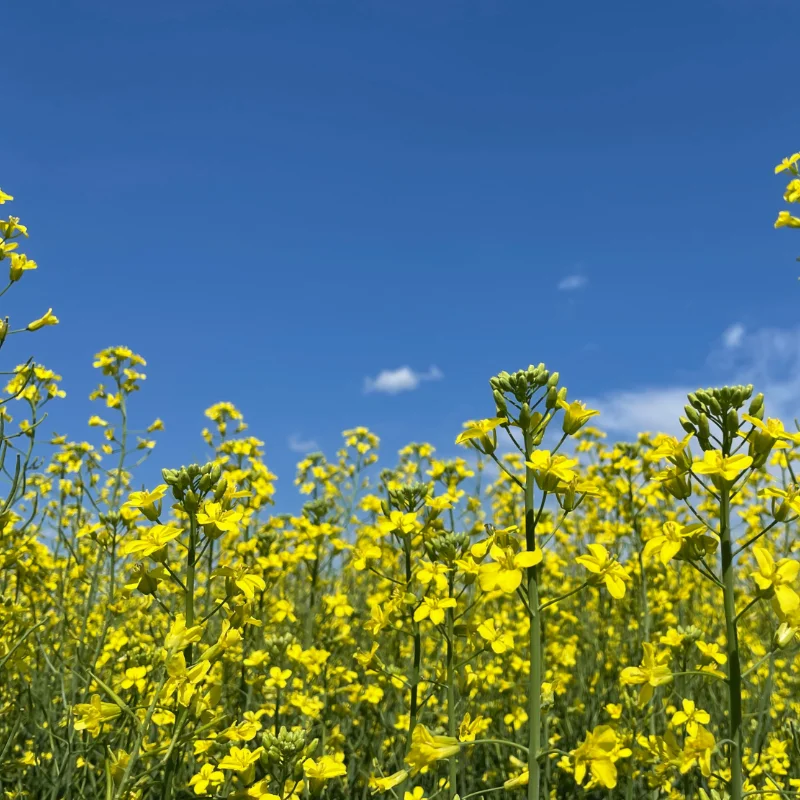
Do you ever wonder what those bright yellow fields are on the Canadian prairies? That’s canola!
Canola, known for its striking yellow blooms and versatile cooking oil, has become essential to farms, kitchens, and Canada’s national economy. A true made-in-Canada success story, canola was bred by Canadian scientists Dr. Baldur Stefansson and Dr. Keith Downey and officially trademarked in 1978. Its name reflects its roots, “can” for Canada and “ola” for oil. This innovation has grown into the foundation of a thriving, sustainable industry that contributes $43.7 billion to the national economy each year, supporting over 206,000 jobs and $16.3 billion in wages. In Manitoba alone, canola adds $6.7 billion to the economy and more than 35,000 jobs annually.
Canola belongs to the crucifer family, a group of plants easily recognized by their four yellow petals arranged in the shape of a cross. The plants grow one to two metres tall and produce slender seed pods about five centimetres long. Each plant holds an average of 60 to 100 pods, and inside each pod are 20 to 30 tiny round seeds only about one millimetre in diameter. As the crop ripens and changes from green to light yellow, these seeds are harvested and crushed to produce canola oil.
Learn More
Growing canola: Canola Encyclopedia
Cooking with canola: Hello Canola
Canola’s economic impact: Canola Council of Canada
History of canola seed development: Canola Encyclopedia